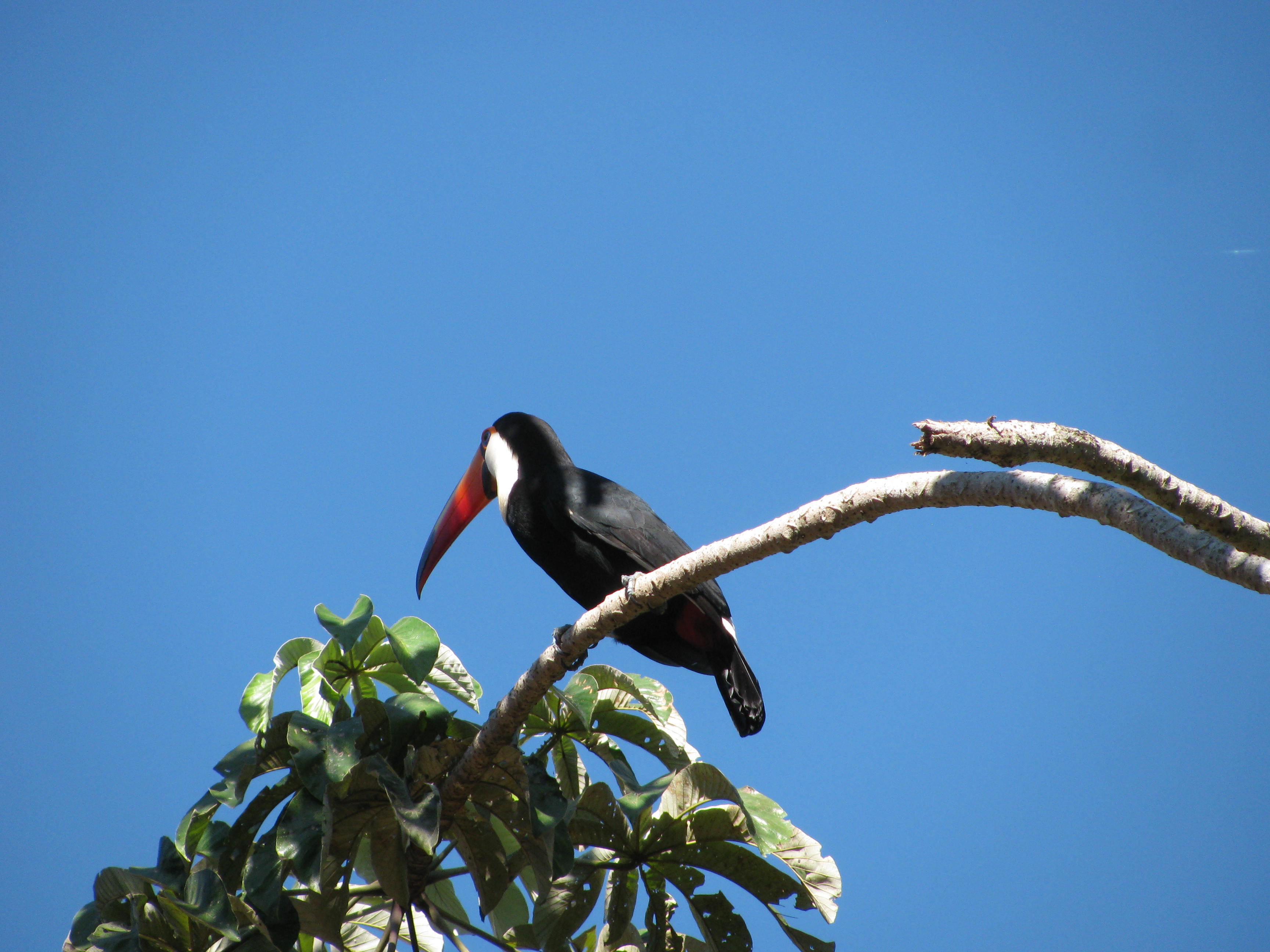
A sophisticated Toucan with his nose in the air.
Reply




A FAMILY FOR EIGHT DAYS…we fly from Buenos Aires to Manaus via Rio. Our hotel for one night is the Tropical, a large unimaginative place painted well on the front but completely deteriorating on the back. For the first time our “red birds” (the birds from the top of our wedding cake) that have been traveling with us have no view from the room. Just for fun I have been siting them at the window of every hotel we have stayed in and taken a photo, I intend to make a collage at the end of the trip with the photos that will be a great reminder of our journey, but the Tropical provided nothing for them to see.
Breakfast at 6.30am as we are instructed to meet our guide from the “Tucano” at 7am. The Tucano, a boat which can accommodate sixteen is going to take us on a seven day trip up the Rio Negro ( a tributary of the Amazon). We look around the dining room and try to see who we think we will be sharing that time with. We worked out who we thought six of them might be and it turns out we were right.
There are eleven of us in total plus two guides and the remainder are the crew of the boat. It is a bit like the first day at school. Personalities to explore and stories to listen to. A father and son from Los Angeles, “quality time with my Dad” is how the son describes what he is looking forward to. The father on the other hand said to me one evening, “after fifty two years of marriage it is nice sometimes to have a break from your wife”! These two charming people took longer than the others to integrate, both it turned out, had an incredible sense of humour but were also quiet and unassuming and like us out to learn about the many birds and creatures on show and of course other aspects of the “forest”
A widow from Toronto and her English friend of seven years were really only here for the Opera. Yes, the Opera has been bringing them together to many parts of the world. The Opera in Manaus is world famous and as there was a week between performances they decided to take this trip up the river. Two very interesting people. The Canadian, a retired lawyer and the English lady a retired Matron. Their humour was infectious and it was so amusing to sit behind them on the canoe and watch their reaction to all the creepy crawlies on display, many of which landed in the boat on them (and us) at times.
A recently widowed grandmother of ninty, two of her three children and a granddaughter, all from San Diego. “Grandma” was game for every outing and her energy was incredible. Both her daughters, saddened at the recent death of their father last September asked their mother where she would really like to go and she came up with this trip. A keen birdwatcher (as were all the family) all her life and a vegetarian since the age of twelve, her enthusiasm was wonderful and for all of us middle aged she was an inspiration, no lie-ins for her, she joined us at 6am for the first outing every day and was still there for the evening excursions which began at 8pm after dinner. She is now very fortunate to have one daughter who will take care of her, another daughter fifteen minutes away, plus a charming granddaughter who made the journey leaving her husband and fifteen year old son for the first time for a week, without contact, ever….
I asked our guide if it would be possible to suggest to our new family that we all move to different tables for every meal (which we did) and then another suggestion was made which he followed, was to join all the tables together. The canoe seating was also changed around on each outing. People become such creatures of habit. An observation that I have made over the years is that people always want to return to the same place they have sat either for a meal or on a bus or wherever. I think in many ways it gives them a certain amount of security. The same can be said of people who return year after year to the same resort for a holiday. I find this puzzling. There is so much to see out there, even a change of seat in the dining room of a hotel presents a different view, a different perspective on everything. I like that.
One seat that could not be changed was for another English lady. One spot on the back of the boat was reserved for smokers. Sadly for her she was the only person to use that position. She was never alone for she always had a book in hand. A native South African but living in the UK for many years, a retired librarian, she travels as much as possible, bright eyed and longing to see more, the only person suffering from her travels is her cat who awaits her return!
And so the family settled in. The bumph we were sent on what to bring emphasized that the two most important things to bring were Patience and Tolerance.
I am writing this on day six and I have to say that neither of the above have had to be put to the test. Just one small blip maybe and that is when pineapple (which was served along with many other fruits for breakfast daily) was also produced as “dessert” today. We have had little variety in the food for the past three days so I was actually looking forward to a delicious dessert (like the one we had two days ago which everyone agreed was the best ever, passion fruit in a sort of mousse) so disappointment rose its head and I felt that others were feeling the same.
The food has been typically Brazilian and possibly we all agree that there has been a bit too much beans and rice. We did however go fishing for Piranha two nights ago and ate them grilled with fresh limes as an appetizer last night, they were unexpectedly delicious. Our three-generation family however are all vegetarians so were not able to join in. The fish we caught varied in size. I have only been fishing once in my life and that was for mackerel where I simply threw the rod over and got a “full house” everytime. Fishing for piranha was slightly different. We were given a rod and bait and sat patiently waiting. All bar one of us managed to catch some. Guy caught the most. Their teeth are very scary and our guide demonstrated how they can cut like scissors, ANYTHING put in their mouths. The same guide mentioned that his niece had had half her finger taken off by one when she was a child. It was however a unique experience and I am proud to say that I caught the biggest one, I did however have a terrible guilt trip when I passed the pan it was lying in two and a half hours later and it was still taking its last gasps.
On our second last day we moored not far from Manaus close to a houseboat community. I was very interested in observing their life. At 6am the school age children were collected by the Escolar and taken to a classroom down river. When we returned from our early morning outing I had a chance to watch the daily chores of the mother in the nearest house. These wooden houses sit precariously on tree trunks to which they are strapped with rope. Each house basically consists of one room. The windows have no glass and when it rains they simply put wood in the space to stop the water coming in. I could see that everyone inside slept in hammocks, I say everyone, as at a guess, each house is probably home to a mother, father, grandmother and however many children they have plus dogs, cats and other animals. There is a small deck about two foot wide around the house so the children have to learn to survive very early as there is nothing to protect them from falling in the water. There is no sanitation. Everything goes in and out of the river. This family had two boats and one was presumably used by the father to go to whatever work he had locally. The “mother” started washing clothes when we left in the morning. There was a piece of rope surrounding the house and gradually the entire building was clad in washing. At this point she turned on some very loud music and sat looking out of the window. At lunchtime two men appeared and from somewhere inside the house food was produced. We are in the rainy season. I myself had tried to dry some clothes on the deck of our boat so I know how difficult it is to get things dry. The humidity is very high, things just get to a point where the moisture is beginning to subside when down comes the rain, practically no warning and as a result everything that I washed ended up smelling mouldy by the end of the trip. I can only imagine how difficult it must be for this mother to get anything dry on a daily basis let alone deal with all the other hardships of daily life. Our boat sailed off at 4pm. Her children were not yet home, her daily grind continued albeit with electricity to see her through the night but how bad it makes one feel that in a country of such incredible natural resources (which Brazil has) that these people have such a daily struggle and how confusing it must be for them to see the “tourists” enjoying the beauty of their surroundings (only a tiny percent of Brazilians ever get to go to the Amazon) from the comfort of an air conditioned boat with plenty of food and clean water….
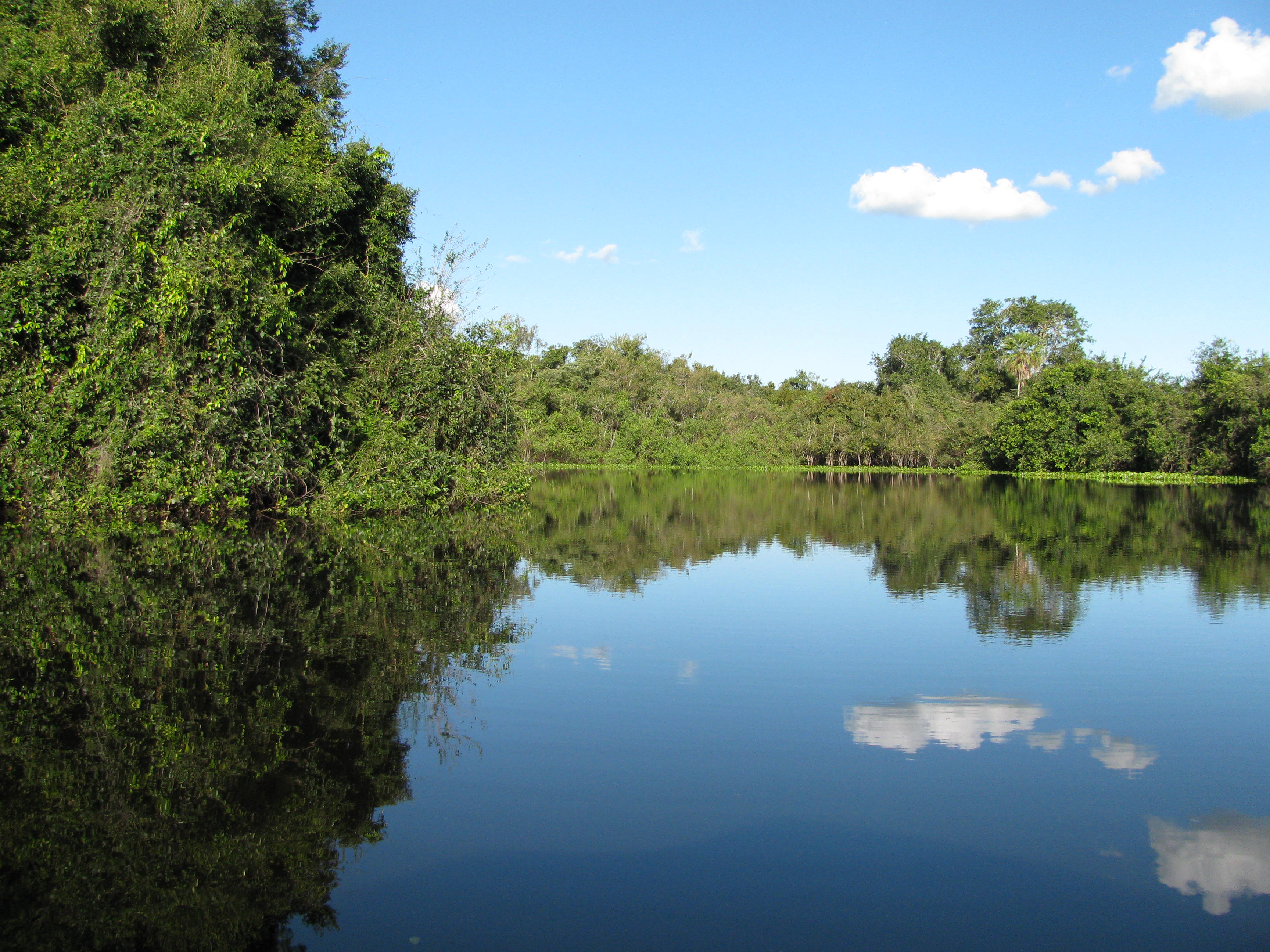
On another note, the trip has been fabulous. The moments of tranquility, being so far away from civilization in that all you can hear are the sounds of the forest and the river, has been extraordinary. We have learnt the names of many bird species, trees and fauna, experienced some demonstrations of what man has used (and are still using) in the forest to survive the rigours, seen snakes and spiders that bring up the hairs on the back of your neck, witnessed monkeys playing, sloths sleeping, and the famous pink dolphins displaying their beauty around our wooden canoes, and so much more. I have tried to understand the minds of the families living along the river whose lives are so far away from “time” itself. I am also still trying to understand why man could be so naive as to want to destroy this beautiful place, I am not sure I will ever understand that. I feel honoured and priviledged that I was a part of this magical place for one week of my life…..
 thebunguycord